

“Tent Camps” in Stepanavan
That is the Lori canyon, where facing each other
The cliffs—with deep furrows gathered—
Standing face to face, stubborn and unblinking
Gaze at each other calmly.
The Lori region is distinguished by its beautiful nature and relatively humid climate. The mountain ranges of Javakhk, Bazum, Pambak, Gugark, Virahayots, and Halab stretch across this land. The forested, soaring mountains, deep gorges, and the roaring rivers that fill them, along with the people living here, are a source of inspiration. All of this makes you want to pack your bags and go to Lori again and again—in our case, to Stepanavan.
CAMPING provides new and unforgettable sensations and requires solving complex, sometimes even dangerous, problems. It is an active, interesting, and useful form of recreation for children and teenagers, as well as the happiness of communicating with nature. Camp is an occasion to make new friends, have new meetings, and make new acquaintances. Here we go through trials together and learn mutual aid skills. Camp is a way for children to become close, to discover the best human qualities, and to learn discipline and routine. By participating in the camp, we gain theoretical knowledge and test practical skills in reality.
And these two important factors (the nature of Lori and the importance of camping) are what drive us to organize camps and develop new programs.
From July 7-13 and August 9-16, we once again organized “TENT CAMPS” in Stepanavan, which were quite successful and received positive feedback. The camp is organized in the shade of pine trees, where you can even see squirrels. Classes are conducted by experienced instructors and rescuers from the Lore Rescue Squad, who, besides being the best in their field, are also great educators. The camp has a mountain orientation, where we learn to overcome natural obstacles that we may encounter in nature and beyond.
Free time after classes is spent playing—the boys are captivated by football, the girls by badminton, and both together by capture the flag, “name shouting,” “duck hunter,” hide-and-seek, and other games. And as soon as it gets dark, we gather around the campfire, for which we collect wood in advance.
Fresh and humid air, the sweet scent of nature, sounds and sights, diverse conversations of children, dear and trustworthy people—what else is needed to have great days?
And if you want to get acquainted and mentally go through the different days of the camp with us, then continue reading:

Day 1
As with all our club’s trips, we meet early in the morning for the camp. Upon reaching Stepanavan, the children set up their tents and arrange their things independently or with the help of someone who knows how to set up a tent. Usually, children from our club and children who are not club members participate in all camps. And the exchange of tent-setting experience is done by the children themselves. For 7 days, the children have to live in the tent they set up with their own hands, so they secure it as well as possible.
In our “Tent Camp,” the most delicious breakfast, lunch, and dinner are served, so after building the tent village, we eagerly rush to lunch. After lunch, we head to the rope challenge park, testing our balance, ability to concentrate, fear of heights, and flexibility. Natural obstacles are often encountered in nature that must be crossed, and passing through this rope challenge park helps to gain experience to some extent.
In their free hours, children play games, read, or paint. In the evening, we gather around the campfire. It should be noted that the children often light the fire themselves—at every camp, we have permanent and voluntary fire-keepers who easily and happily collect and chop firewood, providing us with warmth at night.
Forest, silence, the sound of burning wood in the silence, and fire dancing in the dark. And how could the fire not dance when the children are around the campfire singing sweetly?
Bedtime is perhaps the most anticipated moment, as there are children who are spending the night in a tent for the first time, while those who have experience with tent camping head to the tent impatiently—not to sleep, but to chatter. In the evenings, it is quite cool in Stepanavan, and when sleeping, we settle well into our sleeping bags and fall into a sweet sleep.

Day 2
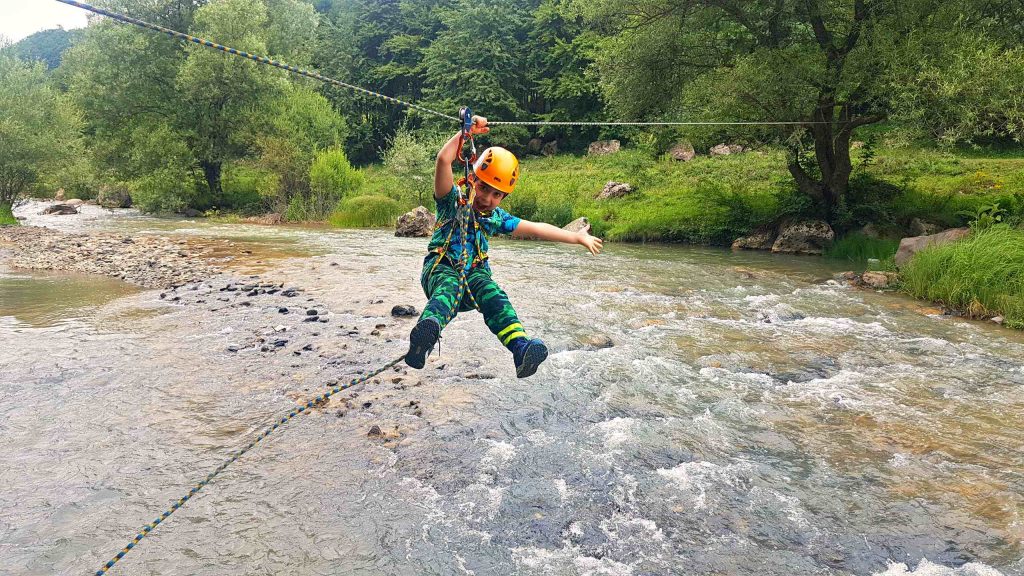
Every morning the alarm was set for 8:00, but the children were usually awake by 6:30 or 7:00. Usually, it was the children spending their first night in a tent who woke up this early, as they were not yet used to sleeping in a sleeping bag on the ground. Despite waking up early, they were so fresh and energetic, as if they always got up at that time. On the 2nd day of the camp, we have a training session that also involves a hike. To reach the training site—a suitable bank of the river we need in the Dzoraget canyon—we have to walk 4.5 km and return the same distance. After breakfast, at 11:00-11:30, we start the hike. After settling in the shade of the trees on the bank of the Dzoraget River, we begin our training: river crossing. The river crossing is done with the help of ropes tied from tree to tree, using equipment, gear, and technical means. We learn how the rope reaches the other bank, how the person taking the rope to the other bank crosses the river, how to put on the safety harness and helmet, how to use the carabiner, and then we cross the river ourselves, hanging from the rope over the foaming swirls of the river. When walking through forests, mountains, and fields, a river often cuts across the path, forcing one to find a way out. Thanks to this lesson, we learned how to overcome this obstacle. After tying the ropes, the instructors from the Lore Rescue Squad taught us how to cross the river, which part is correct to cross from and what methods there are, what time of day mountain rivers are flooded, and many other important things. We all successfully crossed the river and armed ourselves with new skills. After the training, we swam in the river, had lunch, and rested. As a result, we walked 9 km and did a river crossing.
Day 3
It is 8:00 in the morning; many of the children are still asleep, and in such a sweet sleep that you don’t have the heart to wake them. We are gradually getting used to sleeping in a tent and waking up later in the morning. But we must move according to the schedule; we have breakfast at 10:00 AM, and before breakfast, running and gymnastics.
After breakfast, we have a cognitive walk in Stepanavan, during which we definitely visit a playground. We conclude the walk by taking a traditional group photo near the statue of Stepan Shahumyan. After lunch, we gather at the climbing wall. Before starting to climb, the children think they will easily and calmly reach the last stone, but when they put their feet and hands on the first stones, they realize it wasn’t what they imagined. Concentration, balance, correct body position, strength, and flexibility are needed for climbing. Here it is important to trust the rope and the person providing safety. When you gain confidence, you climb more easily, as fear and mistrust are the climber’s greatest enemies.
In their free hours, some rested, some played badminton or football. The football had already reached an inter-regional level. The boys from Stepanavan and the boys from Yerevan had divided into teams and turned the evenings into a football event.
In the evening, games again—Mafia, Halamula, “name shouting,” and definitely a campfire. Finally, we are in the tents and preparing to sleep (unless, of course, the children are plotting mischief).

Day 4
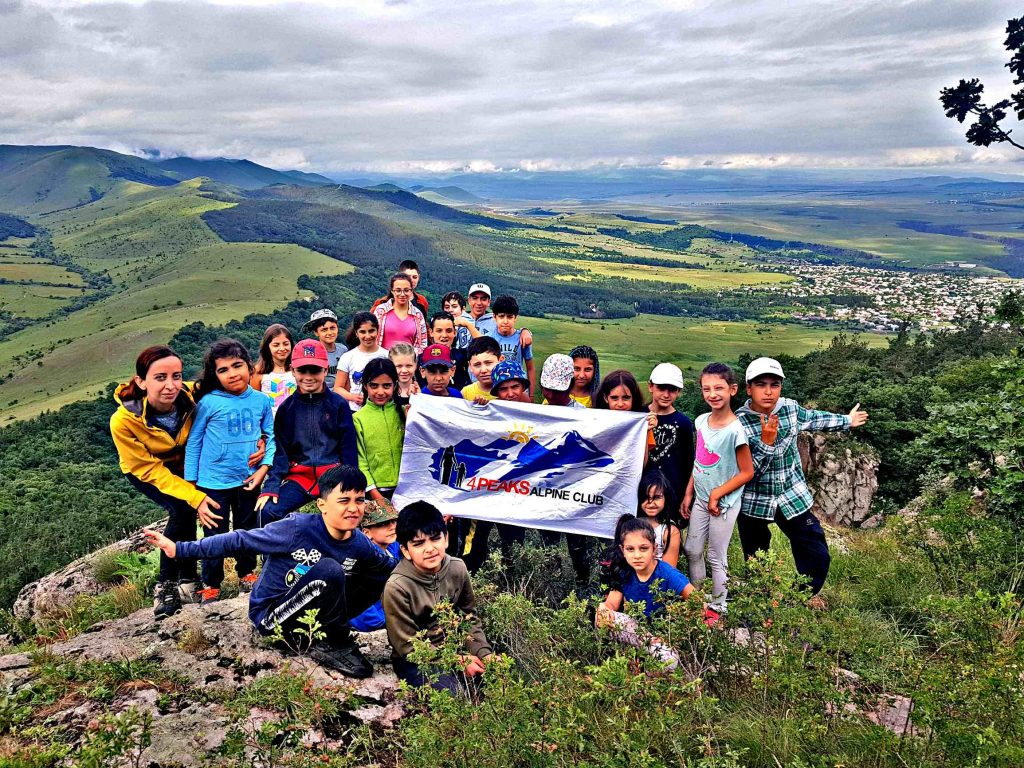
On this day, we wake up earlier than usual because we have to climb Mount Archasar. The previous evening, we had packed our backpacks in advance—rain protection, warm clothes, a water bottle—so in the morning, we only had to get dressed, wash up, get the breakfast prepared for the hike, and go. By 7:15, we were already on our way. According to the weather forecast, there was a chance of rain after 12:00 PM, so we had to manage to get down from the mountain before then. The road to the summit first passes through a road stretching through the forest, then alongside the forest, and approaches the mountain slope, the top part of which is rocky. Walking through the forest, you can’t even imagine that it’s possible to suddenly find yourself out of the forest, above the rocks. And it is at that moment that you feel the happiness of reaching the summit and find yourself in the green of Lori, which has different shades.
After the Yerevan heat, our camp is a real paradise. A gentle breeze, clean air, the chirping of birds, the rustling of trees, the joy and laughter of children—this is our environment.
Day 5
A trumpet? What for? In our camp, the wake-up call is provided by the birds with their song, the squirrels running on the pines with the cones and branches they drop on the tent, and of course, the early-waking children with their loud conversations and laughter. Such mornings ensure a colorful day right from the start.
The 5th day of the camp is full of training—climbing and passing through the rope challenge park. By climbing and going through the challenge park for the second time during the camp, we realize that experience plays a big role. If the first time fear interfered a lot, we were unsure, or we didn’t quite imagine the right way, then the second time everything is much easier.
Some even manage to climb to the very end. The evening for us, according to tradition, ends around the campfire.

Day 6
It’s getting harder and harder to wake the children up. Of course, the reason is the busy days and getting used to sleeping in a tent. And this is where the threat of missing a delicious breakfast forces them to get out of the tent faster.
For the 6th day’s training, we needed rope, a safety harness, a helmet, gloves, descent devices, carabiners, and of course, discipline and courage. We equipped the backpacks with the necessary gear and moved towards the forest, where we organized the training. We found ourselves in a position where there was a forest below us, which stretched up towards the mountain a little further away. The ropes were tied, we reviewed the safety rules, and started the training. We learned how to descend using a descent device on a rope. At first, it is difficult to feel the body weight and correctly control the tool, but after trying a few times, everything falls into place.
And the second exercise is overcoming a swamp obstacle. Of course, we weren’t going to do our training on a real swamp. Using stones, we created the possible passable terrain through which we could overcome the swamp and began to walk carefully. If our foot slipped, it meant the obstacle was not overcome. We ended the training with a competition, during which the fastest girl and boy who crossed without slipping recorded a victory.
In the evening, we lit the last campfire; we all gathered around the fire as one. Despite the evening chill, the warmth coming from the campfire did not let us get cold.

Day 7
On the day of departure, we woke up earlier than usual—at 07:00 instead of 08:00. We wake up early to pack the tents and finalize the packing of things we had partially gathered beforehand. The children suggested sending the instructors to Yerevan by taxi while they stayed at the camp, which, however, was not accepted.
These camp days gave us a lot: knowledge, skills, physical activity, new friends, adventures, closeness with nature, and experience in overcoming fears and difficulties. 52 children participated in the camps. This year’s camps were the 5th and 6th in number, and there were children who were already participating in the camp for the 3rd time. This fact, along with the opinions of children and parents, allows us to speak about the success of the camps, which, however, is not a reason to stay in the same place, but inspires the implementation of new projects.


